Choosing insulation in Canada is not the same exercise it is in milder climates. A home in Saskatoon or Thunder Bay faces heating seasons that stretch past six months, ground temperatures that drop well below zero, and frost lines deep enough to affect foundation wall strategy. The insulation type matters less as an abstract product choice and more as a system decision — one that interacts with vapour barriers, air sealing, and the specific assembly of walls, attics, and basements.

Fibreglass Batts: The Most Widely Installed Option
Fibreglass batt insulation dominates residential construction in Canada because it arrives pre-cut to standard stud spacing — 16 inches on centre for most 2×6 exterior wall framing — and requires no specialized equipment to install. A properly installed 2×6 fibreglass batt achieves approximately RSI 3.5 (roughly R-20 in imperial units), which meets the minimum requirements under the National Building Code of Canada for most climate zones.
The performance caveat is that fibreglass batts are sensitive to gaps. A batt that leaves even a 1-percent air gap around its perimeter can lose 20 percent or more of its effective thermal resistance. This is not a theoretical concern — it shows up consistently in thermal imaging audits of homes built before 2010. Proper installation means cutting batts to fit tightly around electrical boxes, pipes, and blocking, with no voids or compression.
Moisture is a secondary consideration. Fibreglass itself does not absorb water, but cavities filled with batts can accumulate condensation if the vapour barrier is improperly placed or torn. In Canada's cold climates, the vapour barrier goes on the warm-in-winter side of the insulation — typically the interior face of the wall — with seams lapped and taped rather than simply overlapped.
Cellulose Loose-Fill: Attic Coverage and Retrofit Flexibility
Blown-in cellulose is a treated wood-fibre product — most commonly recycled newsprint — ground to a consistency that fills irregular cavities without the gaps that plague batts. In attics, it is the standard upgrade path for homes built before the 1990s, where existing batts have settled or were never installed to current depth targets.

The recommended attic insulation depth in most Canadian climate zones corresponds to RSI 8.6 to RSI 10.6 (approximately R-49 to R-60). Cellulose reaches those targets efficiently: a 400 mm (16-inch) depth of blown cellulose achieves approximately RSI 10.5 at settled density. Natural settling over the first few years typically reduces depth by 15 to 20 percent, which is why installers blow to a higher initial depth than the target.
Cellulose has a mild fire retardant treatment (typically borate-based), which satisfies code requirements for attic installations without an additional coverboard in most jurisdictions. It also performs reasonably well at moderate moisture levels — the borate treatment resists mould — but cellulose should not be installed in assemblies where chronic wetting is expected, such as unventilated crawl spaces with ground moisture issues.
For dense-pack cellulose in closed wall cavities — a retrofit technique where existing drywall is kept and insulation is blown through small holes drilled from the exterior — the product is compressed to a density of around 55 kg/m³, which also functions as a reasonable air barrier within the cavity itself.
Closed-Cell Spray Polyurethane Foam: Highest R-Value, Dual Air Barrier
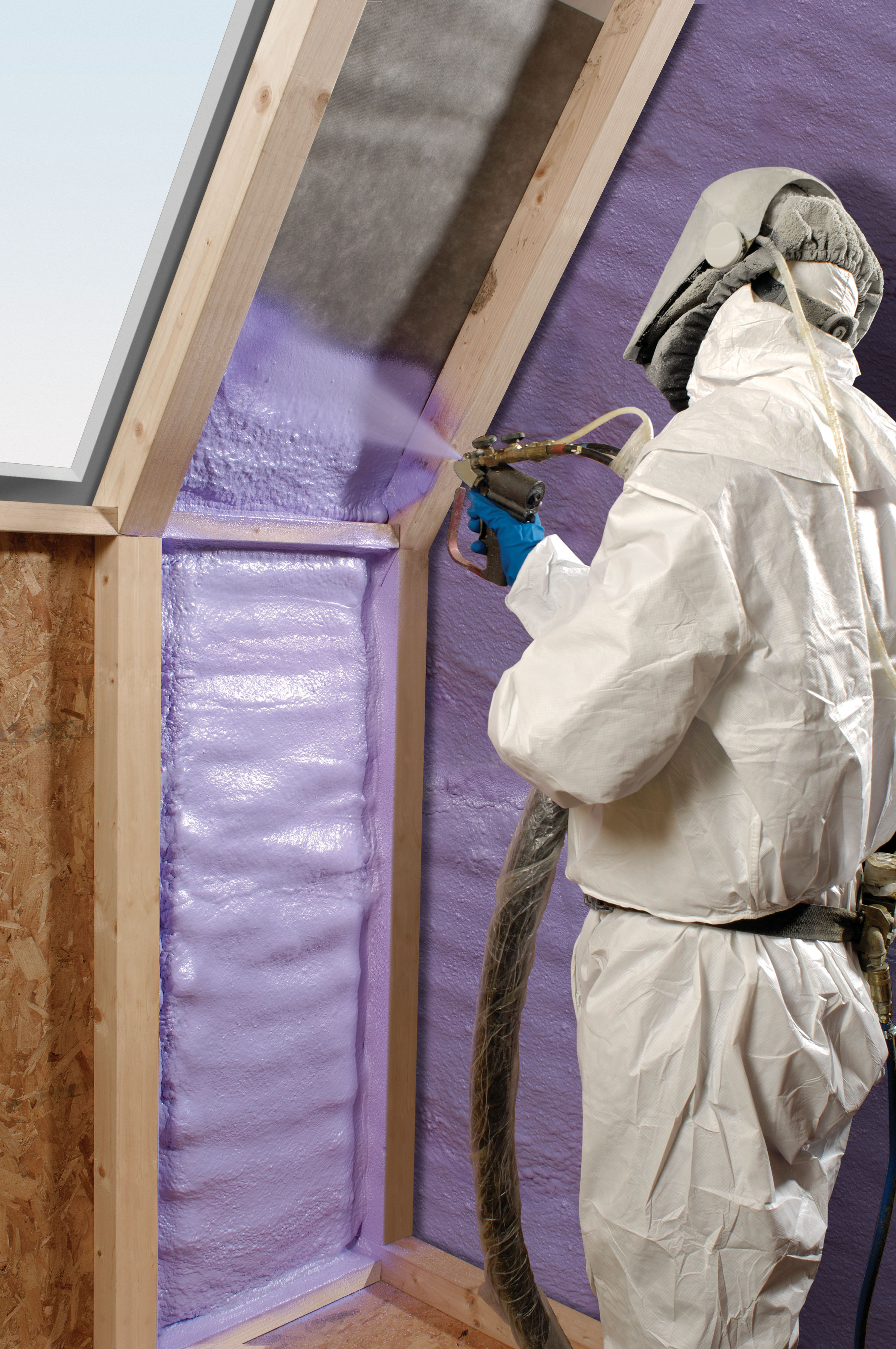
Closed-cell spray polyurethane foam (ccSPF) currently delivers the highest R-value per centimetre of any common residential insulation — approximately RSI 1.1 per 25 mm (R-6.5 per inch). At 100 mm (4 inches), it achieves RSI 4.4 (R-25), and the same thickness functions as both an insulator and a continuous air barrier.
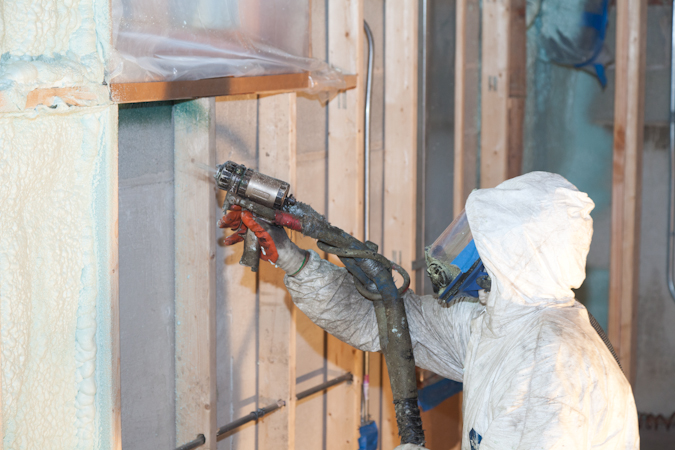
The combination of insulation and air sealing in a single material is the main reason ccSPF is specified for crawl space rim joists, basement walls below grade, and the underside of roof sheathing in unvented assemblies. These are locations where conventional batts fail — not because fibreglass is thermally inferior, but because batts cannot seal the many small penetrations that allow cold air to bypass the insulation entirely.
The limitations are cost and installation sensitivity. ccSPF is typically 3 to 5 times more expensive per RSI unit than fibreglass batts, and it must be applied by certified technicians using calibrated equipment — the two components (polyol and isocyanate) must be mixed at the correct temperature and ratio, or the foam cures poorly and loses both R-value and adhesion. Off-ratio foam is a documented warranty issue in the Canadian market.
Open-cell spray foam is the lower-cost alternative, but it reaches only RSI 0.6 per 25 mm (R-3.8 per inch) and is vapour-permeable, which limits its use in cold climates without a separate vapour barrier on the warm side.
Comparing the Three: A Practical Framework
- Attic new construction or retrofit: Blown cellulose or fibreglass loose-fill to RSI 8.6 minimum. Cellulose fills more evenly around trusses and blocking.
- Exterior walls, new 2×6 framing: Fibreglass batts plus a continuous layer of rigid mineral wool or rigid foam on the exterior sheathing side eliminates thermal bridging through studs.
- Basement rim joists and crawl spaces: ccSPF at 75–100 mm is the most reliable option where air infiltration is the dominant heat loss mechanism.
- Unvented roof assemblies: ccSPF applied to the underside of roof sheathing, meeting the minimum ratio of ccSPF to total insulation thickness required by NBC to prevent condensation within the assembly.
- Wall retrofits with existing drywall: Dense-pack cellulose through drilled access holes, followed by patching.
R-Value vs. RSI: The Canadian Notation
Canadian building codes and energy programs express thermal resistance in RSI units (metric), while most product packaging sold in Canada still lists imperial R-values. The conversion is straightforward: RSI = R ÷ 5.678. The confusion arises because many contractors use R-values in conversation but submit RSI values in permit documents. When comparing products or reviewing an energy audit report, confirm which notation the numbers use before drawing conclusions.
External Reference
The Natural Resources Canada homeowner guide on insulation provides zone-specific RSI targets for walls, attics, and basements across Canadian climate zones, updated periodically to reflect changes to the National Building Code.